
News from ALL
What is coming next in the development of this project?
Amazing news! While we won’t begin building the digital repository until fall 2026, we are now accepting submissions. Please click here to learn more.
Our team of collaborators has expanded. Involved actively in the development of the Lost Library are:
Joshua D. Rubin, Colby College
Kara Kugelmeyer, Colby College
Kate McNally, McGill University
Research Assistants Selene Wang and Max Pettite, Colby College
We remain dedicated to building a network of scholars who are committed to the value of this archive and have knowledge to share. It is in the spirit of building this network that ALL will be collaborating in exciting ways with the American Anthropological Association and Anthropology News in the coming months.
What can you do to help?
Thank you for your interest! You can always contact us here, if you are looking to stay in touch about the project.
We are particularly interested at this stage in chatting with people who have expertise in digital content management.
Anthropology News essay (2026)
Are you interested in learning more about the motivations behind ALL? Read more about those motivations in this recent Anthropology News piece.
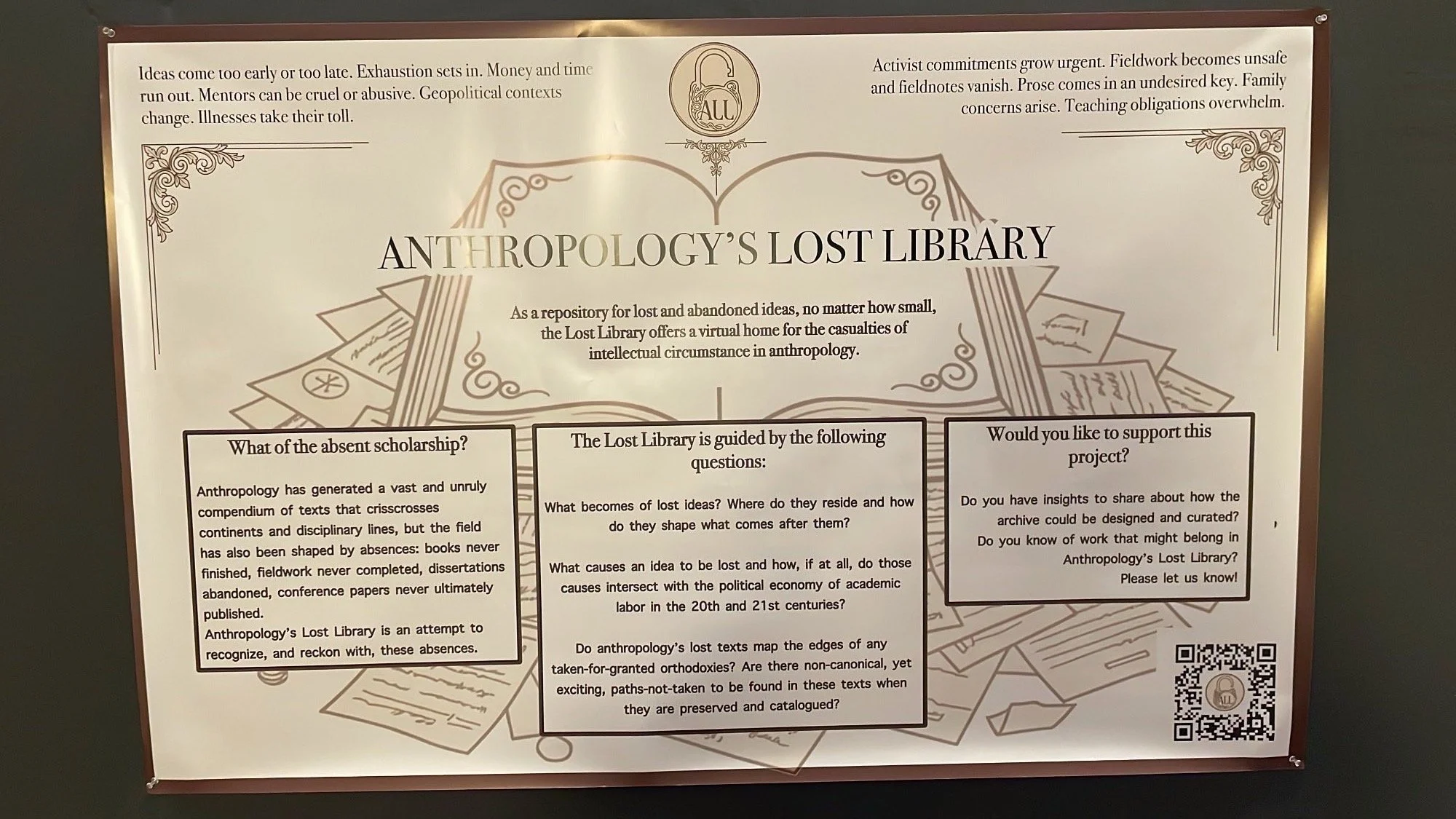
Poster session, American Anthropological Association (2025)
“An archive of gaps, silences, and absences can begin anywhere.”
Thanks to those who visited our poster presentation. The stories you shared were profound.
We heard from retiring senior scholars with unfinished articles, contingent faculty with projects they expected never to complete, and archivists worried that large institutions would either refuse to invest in archiving scholarly papers or would do so in obviously hierarchical ways (e.g. by preserving the writings of scholars already recognized in the discipline). People hinted at traumas of various kinds, overwhelming teaching obligations, illnesses and profound losses.
We got great questions too—about metadata and feasibility and whether or not this archive should be searchable by AI.
In this remarkable session, two things became evident:
First, there is real enthusiasm for this archive, across rank and degree. Everyone with an investment in the discipline of anthropology has work they suspect they will never complete. Everyone, it seems, is aware that the official disciplinary transcripts only tell a fragment (highly curated, highly political) of the discipline’s stories and concerns.
Second, while this archive has the potential to be massive, that potential size is no obstacle to the undertaking of the project. An archive of gaps, silences, and absences can begin anywhere.